


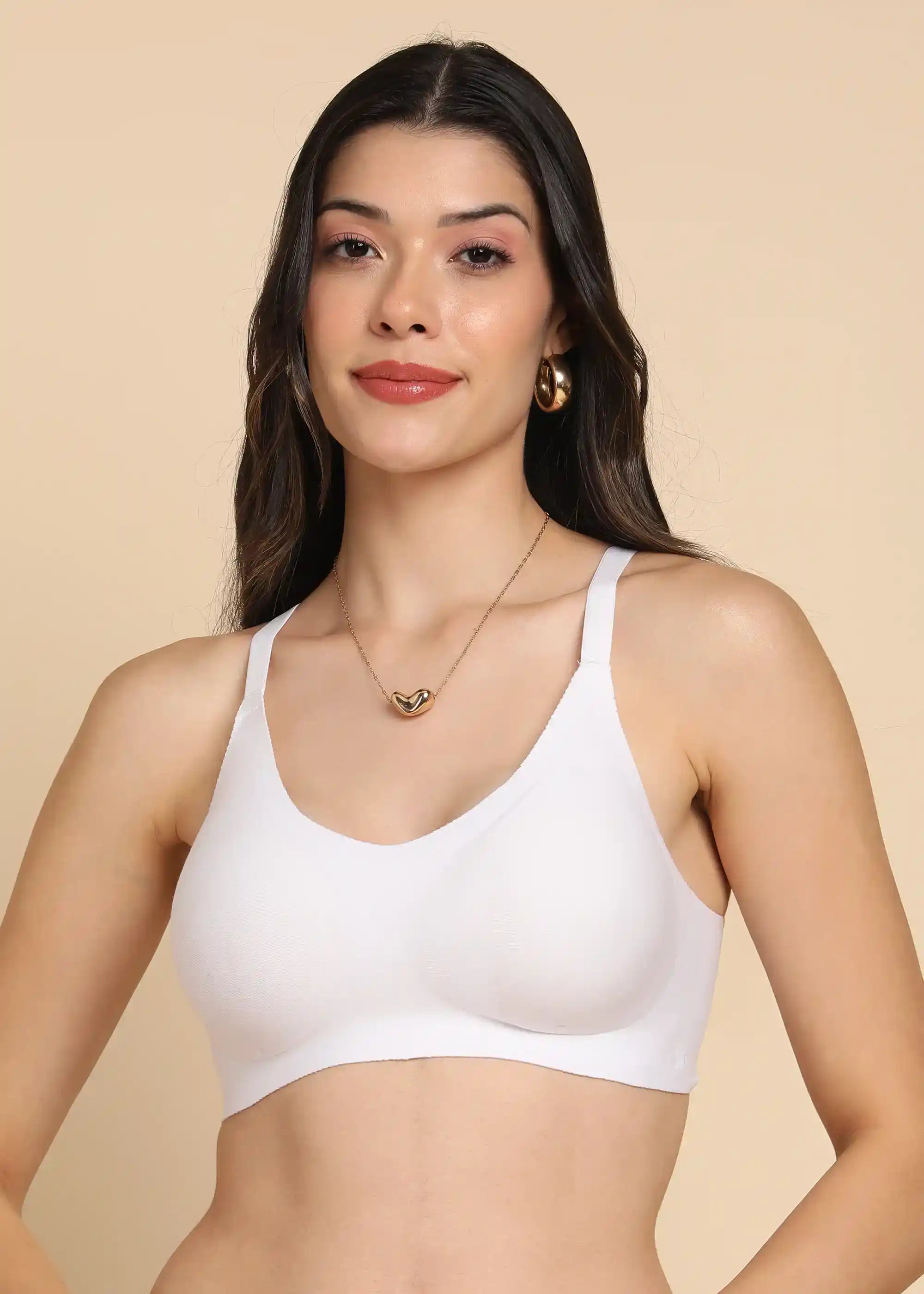

What Is a Bonded Bra? Everything Indian Women Need to Know
Quick Answer: What Is a Bonded Bra?
A bonded bra is a bra made with heat-fused construction instead of traditional stitching. Instead of bulky seams to stitch the fabric panels together, the panels are bonded flat with heat and pressure. The result is a smooth, soft, seam-free bra that wears invisibly under clothing, leaves fewer marks, and is significantly lighter to wear for long hours.
Key Takeaways
- Bonded bras use heat-fused panels instead of stitched seams, creating a smoother finish against the skin.
- Elastic-free bottom band and elastic-free armholes remove the two biggest sources of bra-related digging and irritation.
- Bonded bras sit invisibly under fitted kurtas, shirts, and bodycon outfits because there are no raised seams showing through fabric.
- They are especially suited to Indian climate and daily wear conditions — long hours, heat, commuting, and layered outfits.
- Not all bonded bras are equal. Fabric, internal construction, and brand craftsmanship determine actual comfort.
- Cotton bonded bras offer better breathability in Indian heat. Polyamide gives a smoother, second-skin finish.
Table of Contents
- What Makes a Bra a Bonded Bra?
- How Bonded Construction Works in Practice
- The Problem with Traditional Seamed Bras
- What Are Elastic-Free Armholes and Why Do They Matter?
- What Is an Elastic-Free Bottom Band?
- Bonded Bra vs Traditional Bra: A Head-to-Head Comparison
- Who Should Wear a Bonded Bra?
- Bonded Bras for Indian Women: Why Fit Philosophy Matters
- Types of Bonded Bras Available in India
- How to Choose the Right Bonded Bra for Your Everyday Life
- How to Care for a Bonded Bra
- Expert Insights
- Common Mistakes Women Make When Choosing a Bonded Bra
- FAQs
- Conclusion

1. What Makes a Bra a Bonded Bra?
By the end of the day, most women have owned a bra that left red marks. The underbust band has dug in. The sides have rubbed. Thin lines of irritation left by armhole edges take hours to fade. That discomfort almost always traces back to the same culprit: stitching and elastic.
A bonded bra is constructed differently. Instead of sewing fabric panels together with thread — which creates raised seam lines that press into the skin — a bonded bra fuses its panels using heat and pressure. The result is a flat, smooth surface throughout the bra with no ridge, no thread bunching, and no harsh edge digging into the body.
The term "bonded" refers specifically to this manufacturing process. It has nothing to do with adhesive or sticky surfaces on the outside. The bonding takes place internally at the seam points, replacing thread with a thermal fusion that holds fabric panels together cleanly and flatly.
Quick Answer: What Does "Bonded" Mean in a Bonded Bra?
Question: What does "bonded" mean in a bonded bra?
Answer: "Bonded" refers to the construction method. In a bonded bra, fabric panels are heat-fused together under pressure instead of sewn with thread. This creates smooth, flat edges at every seam point — no raised ridges, no thread friction. The bra looks seamless from the outside and feels significantly softer against the skin during long wear.

2. How Bonded Construction Works in Practice
Understanding how these bras are made helps explain why they feel so different from regular ones.
Traditional Bra Construction
Fabric panels are cut and stitched together on a sewing machine. At every seam — the underarm, the cup edge, the bottom band — a line of thread joins two pieces of fabric. That thread line creates a slight ridge. Over hours of wear, especially in heat or during movement, that ridge presses repeatedly against the skin.
Bonded Bra Construction
A thermal bonding process replaces those thread lines. Fabric panels are aligned and passed through a bonding machine that applies precise heat and pressure at the seam points. The fabric fuses without thread. The seam line remains, but it is now flat — the same thickness as the surrounding fabric rather than raised.
What This Change Delivers
Smoothness Under Clothing
No raised seams means a uniformly flat bra surface. Fitted tops, formal shirts, bodycon outfits, and lightweight kurtas all lie over the bra without showing seam lines or ridges through the fabric.
Comfort Against Skin
With no thread ridges pressing into the underbust, armhole, or cup edges, the bra feels significantly lighter and less intrusive throughout the day. Women frequently describe it as "forgetting you're wearing a bra" — which is exactly the point.
Reduced Friction During Movement
Traditional seams rub repeatedly during movement — walking, leaning over a desk, carrying a bag. Each motion creates micro-friction between the raised seam and skin. Bonded construction removes the raised surface, so friction is significantly reduced.
Quick Answer: How Does Bonded Construction Differ from Regular Stitching?
Question: How does bonded construction differ from regular bra stitching?
Answer: Regular bra stitching joins fabric panels with thread, creating a slightly raised ridge at each seam point. Over hours of wear, this ridge presses repeatedly into the skin. Bonded construction uses a heat-fusion process to join panels at the same fabric level — flat rather than raised. This is why bonded bras cause fewer marks and feel smoother during long daily wear.
3. The Problem with Traditional Seamed Bras
Traditional bras are not badly made. They are simply constructed with a method that prioritises shaping and structure. For occasional wear or short durations, this is often fine. But Indian daily life rarely involves short durations.
A working woman in Delhi may put her bra on at 7 AM and remove it at 9 PM. A college student in Bangalore wears hers through long lectures in non-air-conditioned classrooms. A homemaker moves, bends, lifts, and stretches through a full day. In all these situations, the traditional bra's construction begins to show its limitations.
The Most Common Complaints
Underbust Red Marks
The elastic band at the bottom of a traditional bra maintains constant tension all day. As hours pass, that tension creates visible red marks — and sometimes skin indentations — that take an hour or more to fade.
Armhole Irritation
The elastic at the armhole edge rubs the inner arm and underarm skin area. On humid days, sweat softens the skin and increases friction sensitivity, making the rubbing worse.
Visible Bra Lines
The raised seams of a traditional bra's cups and band create visible outline ridges under thin or fitted clothing — particularly under formal shirts, fitted kurtas, and smooth-surface fabrics.
Constant Adjustment
Traditional elastic tends to roll and shift throughout the day, especially if the fit is not exact. Most women adjust their bra multiple times daily without even thinking about it — pulling the band down, repositioning the cups, re-settling the straps.
Better elastic alone will not solve these problems. They are structural problems. Bonded construction addresses them at the construction level.

4. What Are Elastic-Free Armholes and Why Do They Matter?
The armhole is the curved edge of the bra that runs under and around the arm, separating the cup from the side band. In most traditional bras, this edge is finished with a narrow band of elastic that helps the bra maintain its shape against the body.
That elastic works. But for many women — particularly during long daily wear — it also creates a chronic irritation point. The elastic pushes into the sensitive skin of the inner arm. During movement, the elastic edge rubs repeatedly. In summer heat, the friction intensifies.
What Elastic-Free Armholes Do Differently
Elastic-free armholes replace that elastic edging with a bonded finish. The armhole edge is bonded flat — smooth, pliable, with no elastic tension pulling inward. This changes the daily experience significantly:
- No narrow band pressing into the inner arm area
- No friction edge rubbing during movement
- The armhole sits softly against the skin without the sensation of a bra "grabbing" at that point
For women who find they pull their bra sideways throughout the day, or notice redness under the arm at the end of a long day, elastic-free armholes are often the single feature that makes the biggest difference.
Quick Answer: What Are Elastic-Free Armholes in a Bra?
Question: What does elastic-free armholes mean in a bra?
Answer: Elastic-free armholes means the curved side edge of the bra — where it meets the underarm area — is finished with bonded construction rather than sewn elastic. Without elastic pulling inward at that point, the bra causes less pressure, less rubbing, and less irritation around the inner arm. This is especially noticeable during long wear or warm weather, when skin sensitivity to friction increases.
5. What Is an Elastic-Free Bottom Band?
The bottom band is the horizontal band running directly under the bust. In most traditional bras, this band contains elastic — sometimes thick, sometimes thinner — that maintains the bra's position on the body and provides the structural support base.
Elastic is functional. But it is also the primary source of the red marks most women notice after removing their bra. The elastic maintains consistent inward tension throughout the day. Against soft skin over long hours, that tension leaves marks.
How Elastic-Free Bottom Bands Work
Elastic-free bottom bands in bonded bras use bonded fabric construction to create structure without elastic tension. The band is built with bonded panels that provide enough form-holding to keep the bra in position — without relying on elastic pressure.
The Practical Difference
The underbust area at the end of a long day is likely to show fewer or no marks. The band sits against the body with gentle contact rather than consistent inward pressure. Women who switch from traditional bras to bonded bras most frequently report this as the most immediately noticeable change.
Quick Answer: Why Do Elastic-Free Bottom Bands Reduce Red Marks?
Question: Why do elastic-free bottom bands reduce red marks?
Answer: Traditional bra elastic maintains consistent inward tension against the skin throughout the day. Over 8–12 hours of wear, this tension leaves pressure marks — often red, sometimes deep — that take time to fade. Elastic-free bottom bands use bonded fabric construction to hold position without sustained elastic tension, reducing the pressure against the underbust skin. This is why marks are reduced or eliminated with regular bonded bra wear.
6. Bonded Bra vs Traditional Bra: Head-to-Head Comparison
| Feature | Bonded Bra | Traditional Seamed Bra |
|---|---|---|
| Construction method | Heat-fused panels | Thread-stitched panels |
| Seam finish | Flat and smooth | Slightly raised at seam points |
| Visibility under clothing | Invisible under fitted outfits | Seam lines may show through thin fabric |
| Armhole finish | Bonded, elastic-free | Elastic edging |
| Bottom band | Elastic-free bonded construction | Elastic band |
| Red marks risk | Significantly reduced | Higher with long wear |
| Friction during movement | Low | Higher at seam and elastic points |
| Feel against skin | Soft, second-skin feel | Structured, more pressure-aware |
| Bra lines visibility | Minimal to none | Can show through thin fabrics |
| Long daily wear suitability | High | Moderate |
| Breathability | Depends on fabric (cotton is best) | Depends on fabric |
| Weight feel | Lighter | Heavier due to construction |
7. Who Should Wear a Bonded Bra?
A bonded bra is not a specialty item for a specific body type. It is an everyday comfort upgrade that works across a wide range of situations and lifestyles.
Working Women
If you wear a bra for 10–12 hours on office days, bonded construction eliminates the midday discomfort of elastic and raised seams. You arrive at 9 AM and the bra still feels as comfortable at 7 PM — no marks, no constant adjusting.
College Students
Long lecture sessions in warm, non-air-conditioned environments mean heat builds up through the day. Cotton bonded bras offer breathability plus the seamless comfort of bonded construction for full academic-day wear.
Homemakers and Mothers
Continuous movement — bending, lifting, reaching — means seam friction compounds throughout the day. An elastic-free bonded bra removes the friction sources before they become irritation.
Plus-Size Women
Traditional bras often rely heavily on elastic tension to maintain support for heavier busts. This creates intense underbust marks and armhole pressure. Bonded plus-size bras use broader wings and supportive cup construction to achieve support without relying solely on elastic tension.
Women Who Wear Fitted Clothing
If your wardrobe includes fitted kurtas, formal shirts, bodycon silhouettes, or thin-fabric tops, bonded construction keeps the bra invisible. No seam lines. No ridges through the fabric.
Women with Sensitive Skin
If your skin is easily irritated by fabric friction — particularly around the underbust and underarm areas — bonded construction significantly reduces the contact friction points throughout the day.
Quick Answer: Who Benefits Most from a Bonded Bra?
Question: Who benefits most from wearing a bonded bra?
Answer: Women who wear a bra for long hours benefit most — working professionals, college students, homemakers, and anyone with sustained daily wear of 8 or more hours. Plus-size women also benefit significantly, as bonded construction reduces the heavy elastic tension that traditional plus-size bras rely on, which is a common source of underbust marks and armhole pressure.

8. Bonded Bras for Indian Women: Why Fit Philosophy Matters
Most bra sizing systems and construction philosophies were developed for Western bodies and Western climates. India has neither.
The Indian Body Proportion Difference
Indian body proportions differ significantly from the Western sizing models that most global lingerie brands historically used as their design base. Cup-to-band ratios, torso length, shoulder width, and bust distribution vary across Indian body types in ways that standard Western sizing does not account for well. This is why a bra that fits "correctly" on paper may still feel wrong in practice.
The Indian Climate Demand
Indian climate creates demands that temperate-climate bra design never considered. Summer temperatures in Indian cities regularly exceed 38–42°C. Humidity in coastal cities and during monsoon months keeps skin constantly slightly damp. In these conditions, every fabric friction point becomes significantly more irritating — because softened, humid skin is far more sensitive to repeated friction than dry skin.
Why Bonded Construction Is a Practical Solution for India
A bonded seamless bra designed for Indian conditions addresses both realities:
- Fewer friction points mean less discomfort when humidity amplifies friction sensitivity
- Cotton breathable fabrics manage sweat far better than polyamide or nylon alone
- Elastic-free construction means the bra does not tighten its grip as body temperature rises throughout the day
The combination of bonded construction, cotton breathability, and elastic-free design is not a style preference. It is a functional response to how Indian women actually live — long hours, heat, humidity, layered outfits, and constant movement.
Quick Answer: Why Are Bonded Bras Suited for Indian Women?
Question: Why are bonded bras particularly suitable for Indian women and Indian climate?
Answer: Indian daily life involves long wear hours, high heat, and often significant humidity — conditions where traditional elastic and seam friction become especially uncomfortable because warm, humid skin is more sensitive to friction. Bonded construction removes the seam ridges and elastic tension that cause marks and irritation. Combined with breathable cotton fabrics, bonded bras manage sweat better and maintain comfort through the full length of a typical Indian workday or home day.
9. Types of Bonded Bras Available in India
Not all bonded bras serve the same purpose. Understanding the types helps you identify which one fits your daily life.
Non-Padded Bonded Bra
Provides coverage and support without added padding. Best for women who prioritise breathability and a natural silhouette. The bonded construction handles smoothness; the non-padded cups keep the bra lightweight. Ideal for long daily wear at home or in the office.
Padded Bonded Bra

Adds light padding for gentle shaping and nipple coverage. The padding is typically soft and breathable rather than heavy foam. Good for formal wear and outfits where a smooth, slightly defined silhouette is preferred.
Plus-Size Bonded Bra
Designed with broader wings, deeper cups, and stronger bonded construction to provide adequate support for fuller busts without relying on elastic tension alone. The design considers the specific pressure points that plus-size women commonly experience.
Bonded T-Shirt Bra
Uses smooth polyamide fabric with bonded construction for an absolutely invisible finish under fitted tops. Best for formal shirts, fitted blouses, and close-fit tops where any seam line would be visible.
Bonded Push-Up Bra
Combines bonded seamless construction with push-up padding for going-out or occasion wear. Delivers shape and lift without the discomfort of traditional structured push-up underwiring.
Bonded Minimiser Bra
Uses M-frame construction with bonded finishing and broad wings to distribute and balance bust appearance under fitted clothing. The bonded finish keeps the minimiser effect smooth and invisible under formal outfits.
Bonded Gym Bra
Applies bonded construction to active-wear support. Criss-cross back support combined with bonded seam finishing reduces armhole friction during movement. Cotton or sweat-absorbing fabrics manage workout perspiration.
Backless Bonded Bra
Uses bonded construction with transparent straps and a backless design for deep-back outfits. The seamless finish allows the bra to sit invisibly under garments with low or open backs.
10. How to Choose the Right Bonded Bra for Your Everyday Life
Choosing a bonded bra involves three practical decisions: use case, fabric, and size.
Step 1: Identify Your Primary Use Case
For Office and Long Daily Wear
Choose a non-padded or lightly padded everyday bonded bra with cotton fabric. You need breathability and elastic-free comfort above everything else.
For Fitted Outfits and Total Invisibility
Choose a bonded T-shirt bra in polyamide. The polyamide surface gives a smoother, flatter finish under close-fit clothing.
For Going-Out or Occasion Wear
A bonded push-up or maximiser delivers shape without harsh underwiring or elastic discomfort.
Step 2: Choose Your Fabric Priority
If breathability is your first requirement — which it usually is for most Indian daily wear — look for cotton or cotton-blend bonded bras. If an invisible finish under smooth-fabric outfits is your priority, polyamide bonded bras offer a slightly smoother surface, though with less breathability.
Step 3: Measure Properly Before Ordering
A bonded bra that fits poorly will not deliver the comfort it promises, regardless of how good the construction is. Use the standard band size (measured under the bust) and cup size (the difference between bust and band measurement). Most Indian women benefit from sizing up in cups compared to standard Western sizing guides.
Step 4: Consider Your Body Type Specifically
If you experience side bulge with traditional bras, look for bonded bras with broad wings — the wing extends further around the back to distribute side tissue more evenly. If you are a plus-size woman, choose a bonded bra specifically designed for plus-size bodies rather than a regular bra in a larger size.
Quick Answer: How Do I Choose the Right Bonded Bra for India?
Question: How to choose the right bonded bra for everyday wear in India?
Answer: Start with use case — office wear needs cotton breathability and elastic-free comfort; fitted outfit wear needs a smooth polyamide bonded finish; plus-size bodies need broader wings and stronger cup construction. Measure accurately — most Indian women benefit from sizing up in cups. Prioritise cotton for breathability in Indian heat, and look for elastic-free armholes and bottom band for all-day comfort without marks.
11. How to Care for a Bonded Bra
The bonded construction that makes these bras comfortable requires specific care to maintain its properties.
Washing Instructions
Hand-Wash in Cold or Lukewarm Water
Machine washing, especially on aggressive cycles, can weaken the thermal bonds at seam points over time. Hand-washing is gentler on the construction and extends the bra's life significantly.
Use a Mild Detergent
Harsh detergents can affect both the bonded seams and the fabric texture, particularly for cotton bonded bras.
Never Wring or Twist
Wringing applies torsional force to the bonded panels. Squeeze water out gently instead.
Drying Instructions
Air Dry Flat or Hanging
Tumble dryers apply heat — the same kind of heat used in the bonding process. Prolonged tumble drying can weaken seam bonds. Air drying is always safer.
Do Not Iron the Bonded Areas
High heat from an iron directly on the bonded seams can affect bond integrity.
General Maintenance
Rotate Between Multiple Bras
Wearing the same bra daily does not give the fabric time to recover its shape. Having at least three bras in regular rotation extends the life of each considerably.
12. Expert Insights
Why Indian Women Experience More Bra Discomfort Than Sizing Would Suggest
Indian body proportions — particularly the relationship between underbust measurement and cup volume — often differ from the models that standard global bra construction uses as a baseline. Bonded construction, because it has less rigid structure than sewn cups, adapts more naturally to individual body variation. The absence of hard seam edges means the bra conforms to the body rather than pressing the body to conform to the bra.
The Climate Argument for Bonded Bras
Heat does not simply make a bad bra more uncomfortable. Heat changes the skin's sensitivity to friction. Skin that is warm and slightly damp due to perspiration has increased surface sensitivity — the same friction that feels neutral in an air-conditioned room at 22°C can feel actively irritating at 38°C in outdoor humidity. Removing the friction sources — raised seams, elastic edges — is a practical comfort requirement in Indian conditions, not a luxury.
On the Longevity Question
A well-maintained bonded bra typically lasts 6–12 months with daily wear, which is comparable to a good-quality traditional bra. The misconception that bonded bras are fragile comes from early bonding technology where bond strength was inconsistent. Modern bonded bra construction, produced by experienced manufacturers, delivers comparable durability to traditional construction — provided the bra is washed correctly.
On Support Without Seams
Many women assume "seamless" means minimal support. This is not accurate. Support in a bra comes primarily from the band, the wings, the cup structure, and the strap system — not from seam lines. A well-designed bonded bra with proper wings, a supportive cup, and an appropriate hook-and-eye system provides adequate everyday support across most bust sizes. W-hold and M-frame cup constructions used in quality bonded bras distribute support effectively without rigid seaming.
13. Common Mistakes Women Make When Choosing a Bonded Bra
Ordering the Same Size as Your Traditional Bra Without Re-Measuring
Bonded bras often fit slightly differently from traditional bras because the construction is more pliable. Measure fresh before ordering, and check the brand's specific size guide rather than assuming your standard size transfers directly.
Choosing Polyamide for Everyday Summer Wear
Polyamide bonded bras are incredibly smooth and invisible under outfits. But polyamide does not breathe the way cotton does. If you spend most of your day without air conditioning, a cotton bonded bra will be significantly more comfortable in Indian summer.
Expecting a Bonded Bra to Replace a Structured Support Bra for All Occasions
Bonded bras are excellent for everyday wear and most daily situations. For very high-impact exercise or occasions requiring significant structural lift and definition, a specialised support bra remains the better choice. Knowing when to use each type gives you the best of both options.
Machine Washing on High Heat or Aggressive Cycles
This is the fastest way to shorten a bonded bra's life. The thermal bonds are not designed to withstand repeated machine-wash heat cycles. Always hand-wash or use the delicates cycle in cold water.
Choosing a Regular Bra in a Larger Size Instead of a Plus-Size Specific Bonded Bra
A regular bonded bra scaled up to a larger size is not the same as a bonded bra designed for plus-size bodies. The cup depth, wing width, strap width, and overall architecture differ meaningfully.
Judging Comfort in the Fitting Room Rather Than After 8 Hours
A bra can feel fine during a two-minute trial but become uncomfortable after a full day. When evaluating a bonded bra, ask: Does the band sit flat without digging? Are the armholes comfortable when you lift your arms? Does the cup contain fully without gaping? These are hour-8 questions, not minute-2 questions.
14. Frequently Asked Questions About Bonded Bras
Q1: What exactly is a bonded bra?
A bonded bra is a bra constructed using heat-fused panels instead of traditional thread stitching. Where a regular bra has raised seam lines at the edges of cups, the bottom band, and the armhole area, a bonded bra has flat, smooth surfaces throughout. This removes the main friction and pressure points that cause underbust marks, armhole irritation, and visible bra lines under clothing. The bonded finish makes the bra feel softer against the skin and virtually invisible under most outfits.
Q2: Are bonded bras comfortable for all-day wear?
Yes — all-day comfort is precisely what bonded construction is designed for. The removal of elastic at the armhole and bottom band eliminates the two most consistent sources of bra discomfort during long wear. Women who switch from traditional bras to elastic-free bonded bras typically notice the difference within the first full day of wear. For Indian conditions specifically, the reduced friction and absence of elastic tension is particularly beneficial during long office days, commutes, and hours in heat and humidity.
Q3: Will a bonded bra leave red marks on my skin?
Significantly fewer than a traditional bra, in most cases. Red marks are primarily caused by elastic tension at the bottom band and by raised seam ridges creating pressure points. Bonded bras with elastic-free bottom bands eliminate the elastic tension source, and flat bonded seam construction removes the raised pressure points. Most women who switch to elastic-free bonded bras report a significant reduction or complete elimination of the underbust marks they were used to seeing from traditional bras.
Q4: Do bonded bras provide enough support?
Yes, when chosen in the correct size and style. Support in a bra comes primarily from the band fit, wing construction, and cup structure — not from stitched seams. A well-designed bonded bra achieves support through a properly fitted band, broad wings for side distribution, and supportive cup architecture like W-hold or M-frame design. For plus-size busts, bonded plus-size specific bras with broader wings and reinforced construction provide adequate support without relying on elastic tension.
Q5: Can I wear a bonded bra under fitted kurtas and formal shirts?
This is one of the strongest use cases for bonded bras. Because there are no raised seam lines, a bonded bra sits completely flat under fitted fabric — no ridges showing through the shirt, no cup edge outlines, no bottom band lines. For women who avoid fitted tops or formal shirts because their bra shows through, switching to a bonded seamless bra is typically the most effective solution.
Q6: How is a bonded bra different from a seamless bra?
These terms are often used interchangeably but they are not identical. "Seamless" refers to the absence of visible seam lines on the outside — achievable through bonded construction or through moulded cut-and-sew techniques. "Bonded" specifically refers to the heat-fusion construction method at the seam points. All bonded bras are seamless, but not all seamless bras are bonded. A bonded bra is a specific type of seamless bra where the seam-free finish comes from heat-fusing rather than smooth stitching or moulded foam cups.
Q7: How do I wash a bonded bra to make it last longer?
Hand-wash in cold or lukewarm water using a mild detergent. Gently squeeze out water — do not wring or twist. Air dry by laying flat or hanging. Avoid tumble dryers, as prolonged heat can weaken the thermal bonds at seam points. Do not iron the bra directly. Rotating between at least three bras in regular wear extends each bra's life significantly, as it gives the fabric time to recover between wears.
Q8: Are bonded bras available for plus-size women?
Yes. Plus-size bonded bras are designed with specific architectural differences from standard-size bonded bras — broader wings that extend further around the torso, wider straps to distribute shoulder pressure, deeper cups with more volume, and reinforced bonded construction in the support areas. These differences matter significantly for comfort and support at plus sizes. A standard bonded bra simply scaled to a larger size does not provide the same results as a bonded bra specifically designed for fuller figures.
Q9: How long does a bonded bra last?
With proper care, a bonded bra typically lasts 6–12 months of regular daily wear — comparable to a good-quality traditional bra. The key factor is washing method: machine washing on warm or hot cycles accelerates bond weakening far more than hand-washing. Women who hand-wash consistently report their bonded bras lasting well beyond 6 months. Signs it needs replacing include the bonded seams beginning to separate, the cup structure losing its shape, or the bra no longer sitting smoothly against the body.
Q10: Can I find a bonded bra with cotton fabric for Indian summer?
Yes. Cotton-blend bonded bras combine the breathability of cotton against the skin with bonded construction for the seam-free finish. This combination is particularly practical for Indian daily wear — the cotton manages sweat and keeps the skin cooler, while the bonded construction removes the friction and pressure that traditional elastic causes. Look specifically for bras that describe cotton fabric on the inner skin-contact layer, as some bonded bras use cotton on the outer layer only.
15. Conclusion: The Case for Making the Switch
A bonded bra is not simply a different style of bra. It is a fundamentally different construction approach — one designed to remove the sources of discomfort that most Indian women have simply accepted as part of wearing a bra.
The red marks after a long day. The armhole irritation by late afternoon. The visible seam lines under a fitted outfit. The constant adjusting. These are not inevitable features of wearing a bra. They are features of traditional bra construction — and bonded construction eliminates them.
For Indian women specifically, bonded bras make practical sense: the climate demands breathable, low-friction undergarments, the daily wear hours are long, and the range of outfits — from formal shirts to fitted ethnic wear — all benefit from a truly invisible bra underneath.
The most important thing to remember is that not all bonded bras are equal. The quality of the bonding, the design of the elastic-free elements, the fabric used, and the fit philosophy behind the sizing all determine whether a bonded bra delivers real comfort. Choose a brand that designs specifically for Indian bodies, uses breathable fabrics suited to Indian climate, and backs its construction with genuine manufacturing expertise.
Shop Tweens Bonded Bras — Designed for Indian Women, Built for Indian Life
Tweens' bonded seamless bras combine elastic-free bottom bands, elastic-free armholes, breathable cotton comfort, and heat-fused bonded construction — designed specifically for how Indian women actually live and dress. Whether you need everyday comfort for long office hours, a smooth finish under fitted formal wear, plus-size support without digging, or breathable comfort through Indian summer — Tweens has a bonded bra built for that situation.
Shop the Tweens Bonded Bra Collection → [tweensinvisifit.com]


